

Tools to Manage Risk: How To Automates Enterprise Risk Management
Tools to Manage Risk: How To Automates Enterprise Risk Management
Risk Management Platform
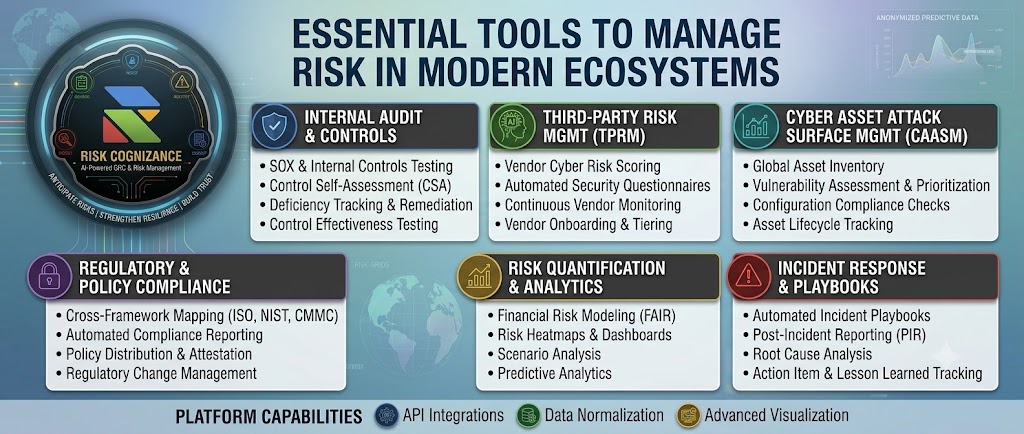
Tools to Manage Risk: How Risk Cognizance Automates Every Layer of Enterprise Risk Management
A comprehensive guide to the built-in tools, integrations, and risk management strategies inside RiskCognizance GRC — covering Risk Scoring, Risk Syncer, Third-Party Risk Management, cyber insurance, and more.
Every organization — from a 12-person defense subcontractor to a Fortune 500 enterprise — faces the same fundamental challenge: how do you identify, measure, and reduce risk before it becomes a breach, a failed audit, or a lost contract? The answer lies in the right risk management tools. This guide covers the full toolkit available inside RiskCognizance GRC, explains the risk management strategies that underpin them, and shows how integrations extend the platform across your entire security and compliance ecosystem.
What Is Risk Management — and Why Do the Tools Matter?
Risk management is the structured process of identifying threats to your organization, evaluating their potential impact, and taking deliberate action to reduce, transfer, accept, or avoid them. In cybersecurity and compliance contexts, that process spans dozens of discrete activities: inventorying assets, assessing third-party vendors, scoring control effectiveness, maintaining audit evidence, and monitoring for new threats in real time.
When those activities are handled through disconnected spreadsheets, email chains, and point solutions, the risk management plan becomes a liability itself. Manual processes introduce human error, create stale data, and make it nearly impossible to see your aggregate risk posture at a glance. Enterprise risk management software solves this by centralizing every workflow inside a unified platform with automated data flows, scoring engines, and continuous monitoring.
RiskCognizance GRC was built for exactly this purpose — and its built-in tools cover the full lifecycle of risk management, from the first assessment through ongoing remediation and executive reporting.
70%
Faster audit readiness with automated GRC platforms
3×
More control gaps found via continuous monitoring vs. annual reviews
60%
Of breaches involve a third-party supplier or vendor

Risk Assessment: The Foundation of Every Risk Management Plan
A risk assessment is the systematic process of identifying what can go wrong, how likely it is to happen, and how severe the consequences would be. Every element of a sound risk management plan flows from a thorough risk assessment. Without one, mitigation strategies are guesswork.
RiskCognizance GRC structures risk assessments around four core components that security and compliance teams work through sequentially — and then revisit on a continuous basis as the threat landscape evolves.
1. Asset and Threat Identification
Before you can assess risk, you need a complete inventory of what you are protecting. The platform maps your digital assets — systems, data stores, third-party connections, cloud environments — and associates known threat vectors with each one. This creates the scope boundary for your assessment and ensures no critical asset is overlooked.
2. Inherent Risk Evaluation
Inherent risk is the level of risk that exists before any controls or mitigations are applied. It represents the raw exposure your organization faces simply by operating in your industry with your particular asset mix. Understanding inherent risk is critical because it establishes the baseline against which you measure the effectiveness of your control environment.
High inherent risk does not automatically indicate a problem — it indicates where your controls need to be strongest. A defense contractor handling Controlled Unclassified Information (CUI) has high inherent risk in data handling by definition. The question is whether the residual risk — what remains after controls are applied — is acceptable.
Inherent vs. Residual Risk
Inherent Risk = the raw risk exposure before controls. Residual Risk = the exposure that remains after all controls are applied. A mature risk management program continuously works to reduce residual risk to within the organization's defined risk tolerance. RiskCognizance GRC tracks both values for every control domain and generates trend reports showing whether your residual risk is improving over time.
3. Risk Likelihood and Severity Scoring
Risk likelihood is the probability that a given threat will materialize into an actual incident. Risk severity is the magnitude of harm that incident would cause — measured across operational, financial, regulatory, and reputational dimensions.
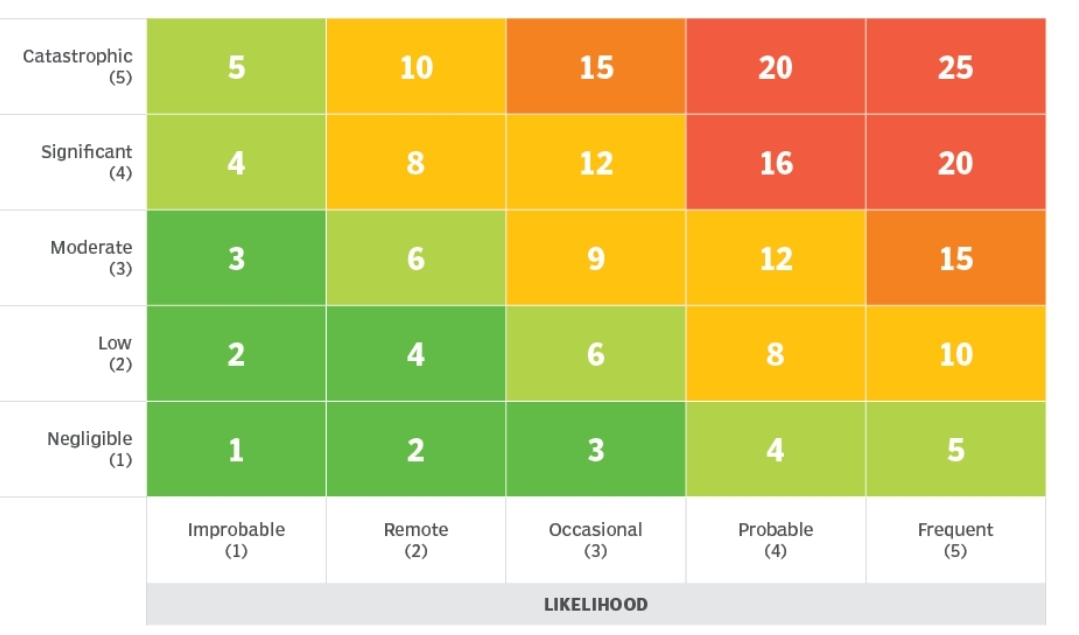
Together, likelihood and severity produce a risk score. The relationship is typically expressed as:
Risk Score Formula
Risk Score = Likelihood × Severity (Impact)
This score determines where a risk lands on the risk matrix, which in turn drives prioritization of your remediation roadmap. High-likelihood, high-severity risks are treated as critical — they require immediate mitigation action and executive visibility.
Risk Heat Map — Likelihood vs. Severity

Risk Scoring Inside RiskCognizance GRC
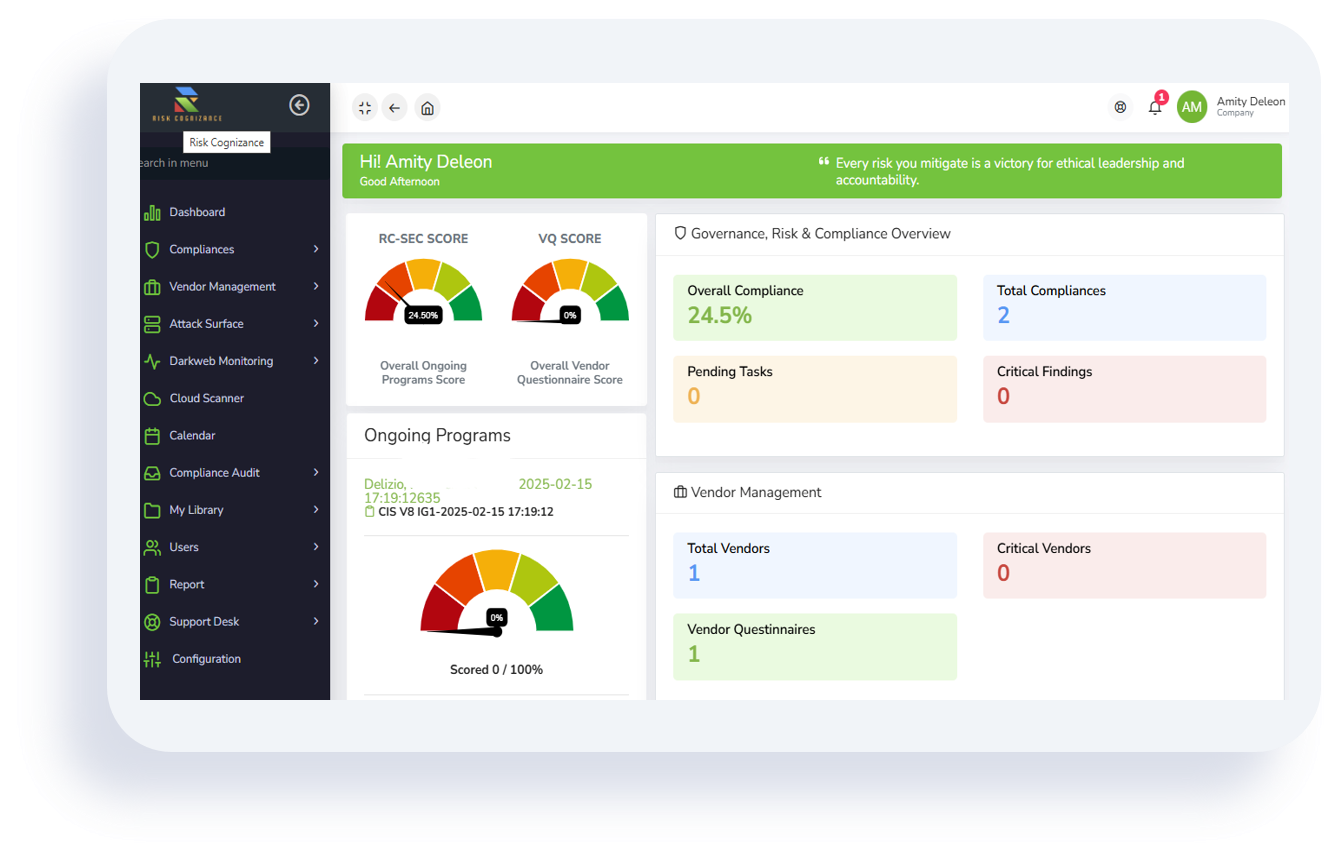
Risk scoring is the quantitative heartbeat of the entire RiskCognizance platform. Rather than relying on subjective, one-time assessments, the platform's scoring engine operates continuously — recalculating scores as new evidence is collected, controls are verified, and the external threat environment changes.
How the Scoring Engine Works
Each control in your environment is assigned a control effectiveness score based on implementation evidence, testing results, and the recency of that evidence. Controls that have not been verified recently are automatically downgraded, preventing the common problem of compliance programs relying on stale attestations.
Control scores aggregate into domain scores — for example, your Access Control domain or your Incident Response domain — which then roll up into an overall organizational risk score. This hierarchy lets executives see the big picture while giving technical teams the granular control-level detail they need to prioritize remediation work.
SPRS Score Calculation and Reporting
For defense contractors operating under NIST SP 800-171 and CMMC requirements, the Supplier Performance Risk System (SPRS) score is a critical output. RiskCognizance GRC automatically calculates your SPRS score in real time based on your current control implementation status, and exports the required System Security Plan (SSP) and Plan of Action and Milestones (POA&M) documentation that accompanies it.
What a Live Risk Score Enables
- Executive dashboards showing risk posture in real time — no manual report compilation
- Trend analysis demonstrating risk reduction over time (critical for board reporting)
- Automated alerts when a score drops below a defined threshold
- Side-by-side comparison across business units, client portfolios, or frameworks
- Pre-assessment readiness verification before a CMMC or SOC 2 audit

Risk Syncer: Eliminating Duplicate Compliance Effort
One of the most painful realities of managing multiple compliance frameworks is the duplication of effort. A control that satisfies NIST SP 800-171 requirement 3.1.1 (Limit information system access) very likely also satisfies ISO 27001 control A.9.1.2 and SOC 2 CC6.1. Without intelligent mapping, your team manually documents, evidences, and attests to each of those requirements separately — tripling the workload for the same underlying technical control.
Risk Syncer is RiskCognizance GRC's proprietary control synchronization engine. It is built on a comprehensive cross-framework control mapping library that understands the relationships between requirements across CMMC, NIST 800-171, NIST 800-172, FAR 52.204-21, SOC 2, ISO 27001, HIPAA, GDPR, and more.
How Risk Syncer Reduces Compliance Workload
When you document a technical control implementation in RiskCognizance, Risk Syncer automatically identifies every framework requirement that control satisfies. The evidence you upload once — a screenshot of your access control configuration, a policy document, a penetration test result — propagates to all mapped requirements simultaneously.
This has several powerful downstream effects:
- Faster framework expansion: When you need to add SOC 2 to your existing CMMC program, the majority of your controls are already mapped and evidenced. You only need to address the genuine gaps, not rebuild from scratch.
- Consistent control language: Because the same implementation statement appears across frameworks, there is no risk of contradictory descriptions creating confusion during audits.
- Reduced evidence burden: Your team collects evidence once per control cycle, not once per framework. For organizations managing three or more frameworks, this can reduce evidence collection effort by 60% or more.
- Change propagation: When a control changes — a new system is deployed, a policy is updated, a tool is replaced — Risk Syncer flags every framework requirement affected, ensuring nothing falls out of sync.
"The single biggest efficiency gain in compliance programs comes from eliminating duplicate effort across overlapping frameworks. Risk Syncer makes cross-framework compliance a single pass, not three separate programs."
Risk Mitigation Strategies: What They Are and How the Platform Supports Each One
Once risks are identified and scored, the next decision is what to do about them. Risk management theory defines four primary risk mitigation strategies — and a mature platform must support all of them, not just one.
| Strategy | Description | When to Use | RiskCognizance Support |
|---|---|---|---|
Risk Avoidance | Eliminate the activity or asset that creates the risk entirely | When the cost of mitigation exceeds the benefit of the activity | Risk register flags high-risk assets; business impact analysis supports discontinuation decisions |
Risk Reduction | Implement controls that lower likelihood or severity | The primary strategy for most operational risks | Control mapping, remediation tracking, continuous monitoring, POA&M management |
Risk Transfer | Shift financial consequence to a third party via insurance or contracts | Residual risk that cannot be cost-effectively reduced further | Cyber insurance risk management module, vendor contract risk tracking |
Risk Acceptance | Formally acknowledge and document a known risk within tolerance | Low-severity risks where mitigation cost is disproportionate | Risk register acceptance workflow with executive sign-off and expiration dates |
Building a Risk Management Plan Around These Strategies
A risk management plan is a living document that defines how your organization identifies risks, who is responsible for each risk domain, what mitigation strategies apply, and how progress is measured and reported. RiskCognizance GRC generates and maintains this plan automatically — pulling from your risk register, control library, and remediation tracking data to produce a current, auditable risk management plan at any point in time.
The plan is structured to support both internal governance and external audit requirements. Every risk in the register is linked to an owner, a treatment strategy, a target remediation date, and the evidence of actions taken. Auditors and regulators can review the full history of any risk decision — when it was identified, how it was scored, what mitigation was applied, and when it was verified as resolved.
- Risk identification: Assets, threats, and vulnerabilities are catalogued through assessments, scans, and third-party reports.
- Risk analysis: Each risk is scored for likelihood and severity to produce a prioritized risk register.
- Strategy selection: Risk owners assign a treatment strategy — avoid, reduce, transfer, or accept — with documented rationale.
- Remediation planning: For reduce and avoid strategies, remediation tasks are created with owners and due dates in the POA&M.
- Monitoring and review: Continuous monitoring detects new risks and tracks remediation progress; periodic reviews validate that scores remain accurate.
- Reporting: Automated dashboards and exportable reports communicate risk posture to leadership, boards, and regulators.
Third-Party Risk Management (TPRM): Managing the Risk You Do Not Control
Your organization's risk posture is only as strong as its weakest supplier. Third-Party Risk Management (TPRM) is the discipline of assessing, monitoring, and managing the risks introduced by vendors, subcontractors, cloud service providers, and other external parties who have access to your systems, data, or networks.
The statistics are sobering: the majority of data breaches now involve a third-party component. For defense contractors, this is not just an operational concern — CMMC explicitly requires that CUI protections extend through the supply chain, making third-party risk management a regulatory mandate, not a best practice.
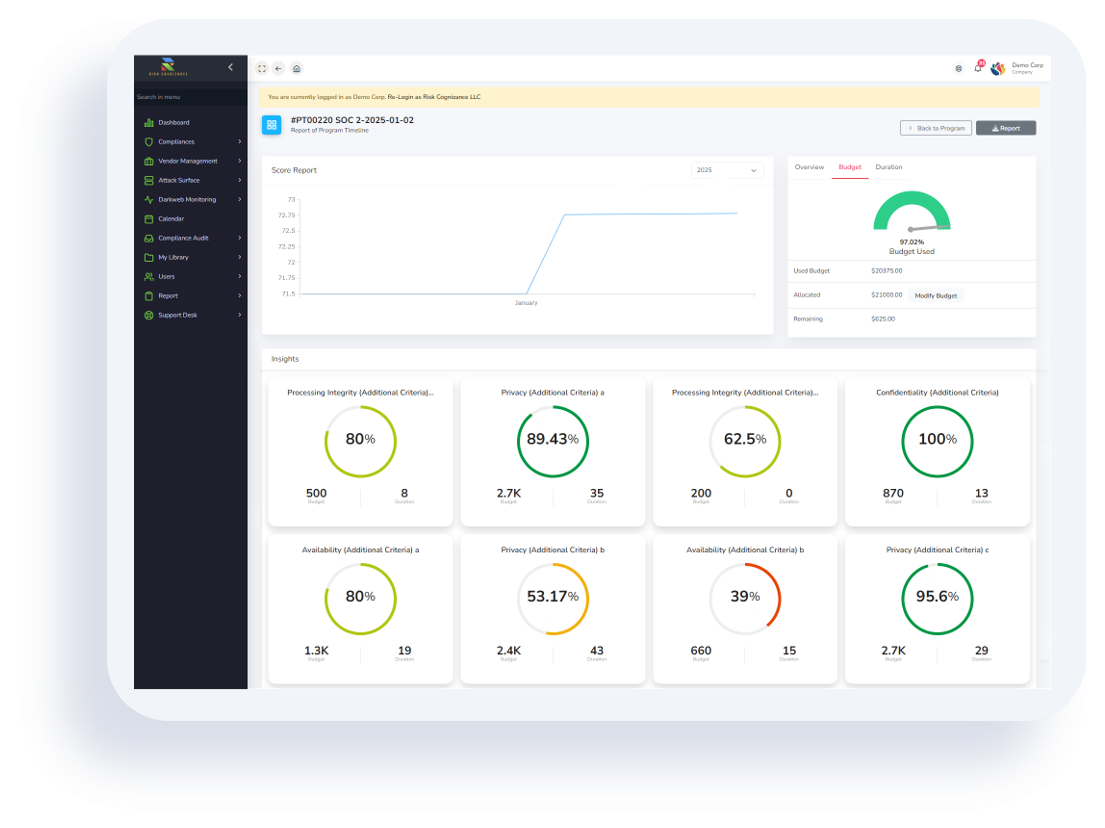
The RiskCognizance TPRM Workflow
📋
Vendor Onboarding Assessment
Standardized questionnaires assess new vendors against your control requirements before access is granted. Risk scores are calculated automatically from responses.
🔄
Continuous Vendor Monitoring
The platform monitors external signals — breach databases, dark web exposure, security ratings — and updates vendor risk scores in real time without waiting for annual reviews.
📊
Vendor Risk Register
Every third party is tracked in a centralized register with risk tier classification, control coverage gaps, remediation requirements, and contract risk terms.
⚠️
Risk Escalation Alerts
When a vendor's security posture changes — a public breach, a failed reassessment, an expired attestation — the platform automatically escalates the risk and notifies the vendor owner.
Tiering Your Vendor Portfolio
Not every vendor deserves the same level of scrutiny. RiskCognizance TPRM supports a tiered vendor classification model based on access level, data sensitivity, and criticality to operations:
| Tier | Criteria | Assessment Frequency | Required Evidence |
|---|---|---|---|
Tier 1 — Critical | Access to CUI, PII, or mission-critical systems | Annually + continuous monitoring | Full security questionnaire, SOC 2 report or equivalent, penetration test results |
Tier 2 — High | Network access, software dependencies, significant data handling | Annually | Security questionnaire, policy attestations, certifications |
Tier 3 — Standard | Limited access, low data sensitivity, easily replaceable | Every 2 years | Abbreviated questionnaire, contractual security requirements |
Tier 4 — Low | No system access, commodity services | As needed | Contractual terms only |
Cyber Insurance Risk Management: Bridging GRC and Coverage
Cyber insurance risk management sits at the intersection of your security controls program and your financial risk transfer strategy. As cyber insurance premiums have surged and underwriting criteria have tightened dramatically, the ability to demonstrate a mature, documented control environment is no longer just a compliance requirement — it is a direct driver of insurability and premium pricing.
How RiskCognizance Supports Cyber Insurance Workflows
Cyber insurance underwriters ask many of the same questions that compliance frameworks require you to answer: Do you have multi-factor authentication? Is privileged access monitored? Do you segment your network? How long does it take to detect and respond to an incident? RiskCognizance GRC maintains the answers to all of these questions — with evidence — as a byproduct of your normal compliance operations.
Key capabilities that directly support your cyber insurance program include:
- Application data export: Pre-populate cyber insurance applications with current control implementation data, eliminating manual questionnaire effort and reducing the risk of inconsistent answers.
- Coverage gap analysis: Map your current control environment against the coverage triggers in your policy — most policies have specific security requirements that, if unmet, can void coverage after a claim.
- Incident documentation: When an incident occurs, the platform's audit trail provides the detailed forensic timeline that insurers require to process claims efficiently.
- Premium negotiation support: Exportable risk posture reports and trend data demonstrate to underwriters that your risk is improving over time, supporting the case for favorable premium treatment.
The Premium Reduction Opportunity
Organizations that can demonstrate a documented, tested control environment — through platform-generated evidence packages rather than self-attestation — routinely achieve better underwriting outcomes than peers of comparable size. The RiskCognizance evidence vault provides exactly the documentation structure that underwriters increasingly require.
Cyber Risk Management Resilience: Moving From Compliance to Continuity
Cyber risk management resilience represents the evolution of GRC from a backward-looking compliance function to a forward-looking operational capability. A resilient organization does not just pass audits — it detects threats faster, contains incidents more effectively, recovers more quickly, and learns from every event to prevent recurrence.
Resilience requires GRC to integrate with operations. That means your risk scores must reflect real-time technical signals, not just policy documentation. It means your incident response plans must be tested, not just written. And it means your risk management tools must connect to the systems that actually defend your environment.
Resilience Capabilities in RiskCognizance GRC
🔍
Continuous Control Monitoring
Direct integrations with endpoint security, SIEM, cloud platforms, and identity systems provide real-time control effectiveness data — not just annual attestations.
🚨
Deviation Alerting
When a control drifts out of compliance — a firewall rule changes, an MFA policy is disabled, a patch falls overdue — the platform alerts the responsible owner immediately.
📈
Incident-to-Risk Linkage
Security incidents are linked to the risk register, automatically updating risk scores and triggering remediation workflows based on what was exploited or exposed.
🔁
Business Continuity Integration
BCP and DR documentation is maintained alongside risk assessments, ensuring that recovery objectives are aligned with your current risk posture and regularly tested.
Built-In Integrations: Extending Risk Coverage Across Your Stack
A risk management platform is only as effective as the data that flows into it. Isolated from your technical environment, even the best GRC software produces compliance theater — polished documentation that does not reflect what is actually happening in your systems. RiskCognizance GRC is designed as an integration-first platform, connecting to the tools your security and IT teams already use to pull real-time control data directly into the risk engine.
Security and Vulnerability Management Integrations
Integration with vulnerability scanners (Tenable, Qualys, Rapid7) ensures that vulnerability scan results feed directly into the risk register. Critical and high vulnerabilities are automatically elevated as risks, linked to the affected controls, and assigned to remediation owners — without manual data entry.
Identity and Access Management (IAM)
Integrations with Active Directory, Okta, Azure AD, and similar identity platforms enable continuous monitoring of access control posture. Orphaned accounts, excessive privileges, and MFA gaps are detected automatically and surfaced as control deficiencies.
Cloud Security Posture Management (CSPM)
For organizations with AWS, Azure, or GCP environments, CSPM integrations provide continuous configuration compliance data. Misconfigured storage buckets, open security groups, and unencrypted databases are detected and mapped to the relevant framework controls, triggering alerts before they become breaches.
Ticketing and Workflow Systems
Integration with Jira, ServiceNow, and similar platforms ensures that remediation tasks created in RiskCognizance flow directly into the tools your engineering and operations teams work in daily. Completion of a Jira ticket automatically updates the control status and evidence record in the GRC platform — eliminating the manual reconciliation step that plagues siloed implementations.
GRC and Compliance Ecosystem
For organizations that supplement RiskCognizance with specialized tools — security awareness training platforms, penetration testing management systems, policy management portals — API-based integrations allow bidirectional data sharing, maintaining a single authoritative risk posture across the full compliance ecosystem.
| Integration Category | Example Tools | Risk Data Contributed |
|---|---|---|
Vulnerability Management | Tenable, Qualys, Rapid7, Nessus | CVE inventory, severity scores, patch status, remediation timelines |
Identity & Access | Okta, Azure AD, Active Directory, CyberArk | MFA coverage, privileged access, orphaned accounts, access review status |
Cloud Security (CSPM) | AWS Security Hub, Prisma Cloud, Wiz, Defender for Cloud | Misconfiguration findings, compliance benchmark scores, exposed resources |
Endpoint Security | CrowdStrike, SentinelOne, Microsoft Defender | EDR coverage, detection events, policy compliance status |
SIEM / Log Management | Splunk, Microsoft Sentinel, IBM QRadar | Threat detections, anomalous access, incident correlation |
Ticketing / ITSM | Jira, ServiceNow, Zendesk | Remediation task status, SLA compliance, change records |
Security Ratings | BitSight, SecurityScorecard | External-facing risk scores, vendor security ratings, industry benchmarks |
Multi-Framework and Multi-Tenant: Risk Management at Enterprise Scale
For enterprise organizations and managed service providers (MSPs), risk management does not exist within a single framework or a single business unit. Enterprise risk management software must scale to match the complexity of real organizations — multiple subsidiaries, multiple client environments, multiple regulatory regimes — without multiplying the administrative burden proportionally.
Multi-Framework Coverage in a Single Platform
RiskCognizance GRC's unified compliance engine supports all major frameworks from a single control library. Adding a new framework does not mean building a new compliance program — it means extending your existing one. Frameworks currently supported include:
- Federal and DoD: CMMC Levels 1, 2, and 3; NIST SP 800-171; NIST SP 800-172; NIST SP 800-53; FAR 52.204-21; FedRAMP
- Industry certifications: SOC 2 Type I and II; ISO 27001:2022; ISO 27701
- Healthcare: HIPAA Security Rule; HICP; HITRUST
- Privacy: GDPR; CCPA; CPRA
- Financial services: PCI DSS 4.0; NY DFS Cybersecurity Regulation (23 NYCRR 500)
- Critical infrastructure: NERC CIP; ICS/OT security standards
_1725822920.png)

Multi-Tenant Architecture for MSPs and Enterprise
The multi-tenant architecture allows MSPs and large enterprises to manage compliance across dozens or hundreds of distinct environments from a single master dashboard. Each client or business unit maintains isolated data, its own risk register and control library, and its own scoring — while the master tenant has aggregated visibility, benchmarking capability, and centralized policy management.
Building and Maintaining a Risk Management Plan With RiskCognizance
A risk management plan is not a document you create once and file away. It is a living governance artifact that must reflect the current state of your risk environment, control implementation, and treatment decisions. RiskCognizance GRC treats the risk management plan as an output of the platform — automatically generated and continuously updated from the underlying risk data — rather than a separate document that must be manually reconciled with the system of record.
Core Components of a Platform-Generated Risk Management Plan
- Risk appetite and tolerance statements: Defined thresholds that establish what level of residual risk is acceptable in each domain, against which all scores are benchmarked.
- Risk register: The complete inventory of identified risks with scores, owners, treatment strategies, and status — maintained automatically from assessment and monitoring data.
- Control framework mapping: Documentation of which controls address which risks across which frameworks, produced by Risk Syncer.
- Remediation roadmap: Prioritized remediation tasks with owners, due dates, and resource requirements — derived from POA&M data and risk score prioritization.
- Monitoring and review schedule: Defined cadences for reassessment, continuous monitoring thresholds, and escalation procedures — enforced by the platform's alerting engine.
- Reporting structure: Templates for board-level, executive, and operational reporting that map to the governance structure the plan defines.
Conclusion: From Risk Exposure to Risk Intelligence
Effective risk management is not about eliminating risk — it is about understanding it clearly enough to make informed decisions about where to invest in controls, when to transfer exposure through insurance, and how to communicate your posture to leadership and regulators with confidence.
The tools inside RiskCognizance GRC — Risk Syncer, Risk Scoring, Third-Party Risk Management, continuous monitoring, cyber insurance integration, and the full integration ecosystem — are designed to turn the overwhelming complexity of enterprise risk management into a manageable, automated workflow. The result is an organization that does not just pass audits, but operates with genuine risk intelligence: knowing where it is exposed, what it has done about it, and what remains to be addressed.
Whether you are a defense contractor working toward CMMC certification, an MSP managing compliance for dozens of clients, or an enterprise organization navigating a complex multi-framework environment, the right risk management software does not add to your team's workload. It multiplies their effectiveness — turning manual, error-prone processes into continuous, automated assurance.
Ready to See the Platform in Action?
Schedule a personalized walkthrough with a RiskCognizance compliance automation expert. We will map your specific framework requirements, review your current risk management plan structure, and show you exactly how the platform's built-in tools and integrations address your highest-priority gaps.
Table of Contents
- What Is Risk Management?
- Risk Assessment Fundamentals
- Risk Scoring Engine
- Risk Syncer Explained
- Risk Mitigation Strategies
- Third-Party Risk Management
- Cyber Insurance Integration
- Cyber Resilience Capabilities
- Built-In Integrations
- Multi-Framework at Scale
- Risk Management Plan
- Conclusion
See Risk Management Automated
Schedule a personalized platform walkthrough with a compliance automation expert.
Key Platform Capabilities
- AI-powered control mapping
- Risk Syncer cross-framework sync
- Live Risk Scoring & SPRS
- Third-Party Risk Management
- Automated evidence vault
- Cyber insurance data export
- Continuous control monitoring
- Multi-tenant MSP dashboard
- One-click SSP & POA&M generation
Frameworks Supported
- CMMC Level 1, 2 & 3
- NIST SP 800-171 / 800-172
- FAR 52.204-21
- SOC 2 Type I & II
- ISO 27001:2022
- HIPAA / HITRUST
- GDPR / CCPA / CPRA
- PCI DSS 4.0
- FedRAMP
RiskCognizance GRC is an AI-powered enterprise risk management and compliance automation platform serving defense contractors, MSPs, and enterprise organizations.
