

What Exactly is a System Security Plan (SSP)?
What Exactly is a System Security Plan (SSP)?
What Is a System Security Plan (SSP)? A Complete Guide
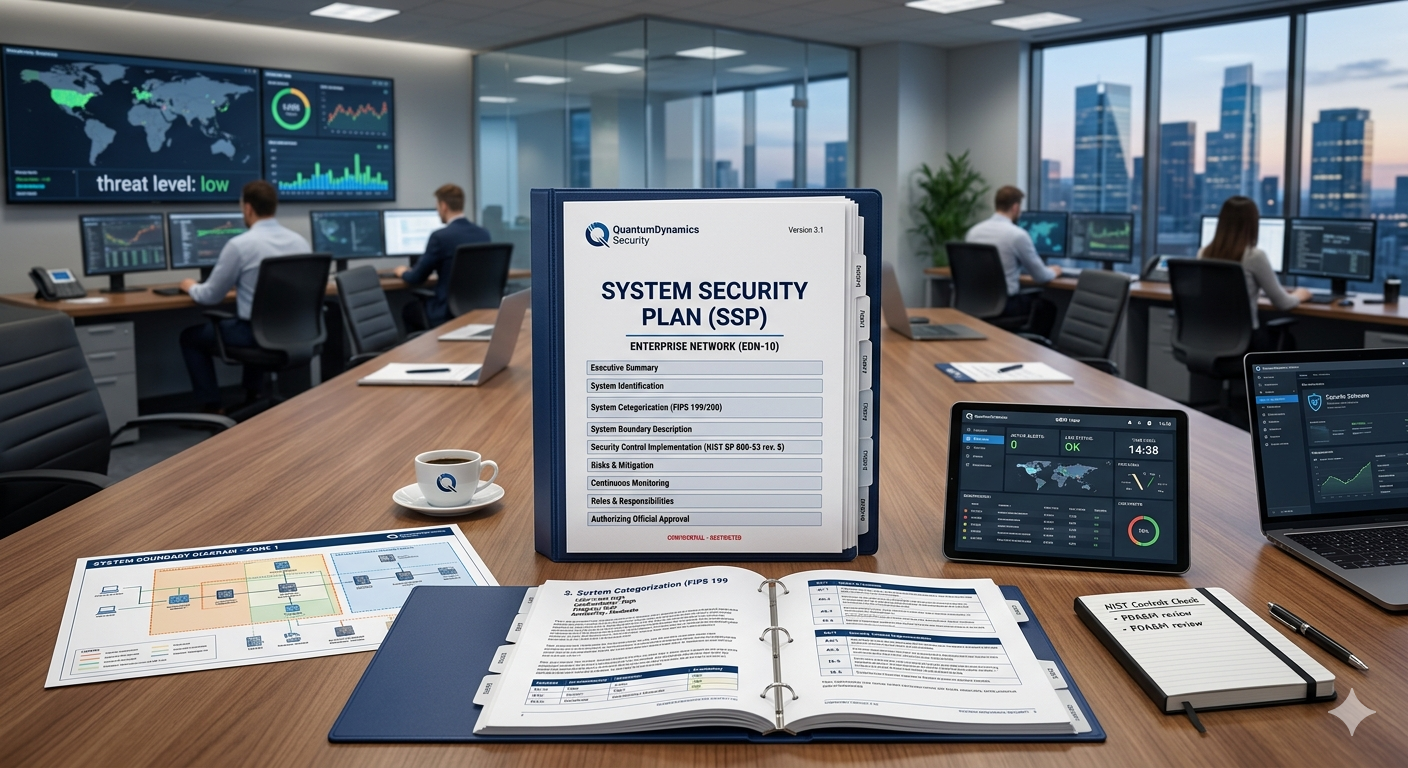
A System Security Plan (SSP) is a comprehensive document that describes how an organization's information system is secured and how security controls are implemented, managed, and maintained. It serves as the foundational blueprint for demonstrating compliance with cybersecurity regulations while providing clear visibility into your system's overall security posture.
An SSP typically documents:
- System boundaries and architecture
- Security roles and responsibilities
- Implemented security controls
- Risk management processes
- Data flows and information classifications
- Access control mechanisms
- Incident response procedures
- Continuous monitoring activities
- Third-party integrations and dependencies
For organizations pursuing compliance frameworks such as NIST 800-53, FedRAMP, CMMC, StateRAMP, SOC 2, or ISO 27001, the SSP is one of the most critical artifacts during assessments, audits, and authorization activities. It gives auditors, assessors, and stakeholders detailed evidence of how security requirements are met and maintained.
More than a compliance checkbox, a well-maintained SSP is a living document that evolves alongside your system — reflecting changes in technology, processes, and security controls, while helping security teams maintain consistency, close gaps, and manage risk.

Why Is a System Security Plan Important?
A strong SSP serves several critical functions:
- Documents your organization's security posture
- Demonstrates compliance with regulatory and contractual requirements
- Provides transparency for auditors, customers, and regulators
- Establishes clear accountability for security controls
- Supports continuous monitoring and risk management
- Creates a repeatable framework for managing security across the system lifecycle
Without a well-maintained SSP, organizations struggle to prove compliance, identify control gaps, and communicate security responsibilities — often leading to costly findings during audits.
How to Create a System Security Plan: Step-by-Step
Developing an SSP can seem daunting, but breaking the process into structured steps produces a comprehensive, audit-ready document.
Step 1: Define the System Boundary
Clearly identify the system being documented. Include:
- System name and purpose
- Hosting environment (cloud, on-premise, hybrid)
- Physical and logical boundaries
- Connected systems and dependencies
- Cloud service providers and third-party services
A well-defined system boundary prevents scope confusion and determines which controls apply.
Step 2: Document the System Architecture
Create diagrams and narratives that explain how the system operates:
- Network architecture diagrams
- Data flow diagrams
- Infrastructure components
- Applications and services
- User access paths
- Security zones and segmentation
Visual documentation helps both technical teams and auditors understand the environment quickly.
Step 3: Identify Applicable Security Controls
Determine which compliance framework governs your organization — NIST 800-53, FedRAMP, CMMC, StateRAMP, SOC 2, or ISO 27001 — and document how each control is implemented, managed, and monitored within your environment.
Step 4: Assign Roles and Responsibilities
Formally define ownership for:
- Security operations
- System administration
- Risk management
- Incident response
- Compliance management
- Continuous monitoring
Auditors consistently look for evidence that security responsibilities are formally assigned and understood by the people holding them.
Step 5: Document Security Policies and Procedures
Reference or summarize the organization's:
- Access control policies
- Change management procedures
- Vulnerability management processes
- Incident response plans
- Business continuity and disaster recovery plans
- Security awareness training programs
The SSP should connect each security control to the policies and procedures that support it.
Step 6: Describe Control Implementations in Detail
For each applicable control, document:
- What has been implemented
- How it operates in your environment
- Who is responsible
- What evidence supports the implementation
- How effectiveness is monitored
Avoid generic statements — assessors need descriptions that reflect your actual environment, not boilerplate language.
Step 7: Conduct an SSP Gap Analysis
Compare your SSP against framework requirements and identify:
- Missing controls
- Incomplete documentation
- Unassigned responsibilities
- Weak evidence collection
- Areas requiring remediation
Proactive gap analysis reduces surprises — and findings — during audits and third-party assessments.
Step 8: Establish a Continuous Maintenance Program
An SSP is never truly "done." Update it when:
- New systems are deployed
- Infrastructure changes occur
- Policies are revised
- Security controls are modified
- Third-party relationships change
- New compliance requirements emerge
A stale SSP creates real compliance risk and undermines credibility during audits.

Common SSP Challenges (and Why They Happen)
Even organizations with mature security programs struggle with SSP development and maintenance:
- Security documentation is distributed across multiple teams with no single owner
- Rapidly evolving technical environments outpace documentation efforts
- Control implementations aren't consistently captured
- Compliance requirements vary across overlapping frameworks
- Internal teams lack the bandwidth for ongoing maintenance
- Evidence collection remains largely manual and error-prone
The result: organizations enter audits with outdated documentation, incomplete control descriptions, and unnecessary compliance exposure.
SSP Requirements by Framework: What You Need to Know
Different frameworks have different SSP expectations. Here's a quick reference:
| Framework | SSP Requirement |
|---|---|
| NIST 800-53 | Formally required; maps to PL-2 (System Security Plan) |
| FedRAMP | Mandatory; one of the core authorization package deliverables |
| CMMC | Required for Levels 2 and 3; must align with NIST SP 800-171 |
| StateRAMP | Required; follows FedRAMP SSP structure |
| SOC 2 | Not a named deliverable, but system description is foundational |
| ISO 27001 | Addressed through the Statement of Applicability (SoA) and ISMS documentation |
Understanding your specific framework's requirements before drafting your SSP avoids rework and scoping errors.
System Security Plan FAQs
How long does it take to write an SSP? Timelines vary by system complexity and framework, but organizations typically require 4–12 weeks for an initial SSP, depending on the availability of existing documentation and subject matter experts.
How often should an SSP be updated? At minimum, annually — and whenever significant system, policy, or control changes occur.
Who is responsible for the SSP? Typically the Information System Owner (ISO) or CISO, with contributions from security, IT, legal, and compliance teams.
Can one SSP cover multiple systems? Generally no. Each system with distinct boundaries should have its own SSP, though common controls can be documented at the organizational level and inherited.
How Risk Cognizance Supports SSP Development
Risk Cognizance helps organizations simplify SSP development, maintenance, and audit readiness across frameworks including NIST, FedRAMP, CMMC, StateRAMP, SOC 2, and ISO 27001.
Our services include:
- Developing comprehensive, audit-ready SSPs from scratch
- Facilitating system boundary and architecture documentation
- Mapping controls across multiple compliance frameworks
- Performing SSP gap assessments and readiness reviews
- Supporting evidence collection and control validation
- Maintaining SSPs as living documents through continuous compliance programs
- Preparing organizations for audits, assessments, and authorizations
Whether you're building your first SSP or overhauling an outdated one, Risk Cognizance provides the expertise to streamline compliance and strengthen your security governance.
The Bottom Line: A Strong SSP Is a Strategic Asset
A well-developed, consistently maintained System Security Plan enables organizations to:
- Improve visibility into controls and security responsibilities
- Accelerate audit and assessment preparation
- Demonstrate due diligence to customers, partners, and regulators
- Reduce compliance and operational risk
- Support long-term cybersecurity maturity
- Build stakeholder trust
An SSP isn't just a compliance requirement — it's the foundational document that proves how your organization protects its systems, data, and operations. Organizations that treat their SSP as a strategic asset are better positioned to manage risk, achieve compliance, and respond to evolving security challenges.
Ready to strengthen your SSP? Contact Risk Cognizance to learn how we help organizations turn compliance documentation into a competitive advantage.
