

AI is the Killer for Small Businesses
AI is the Killer for Small Businesses
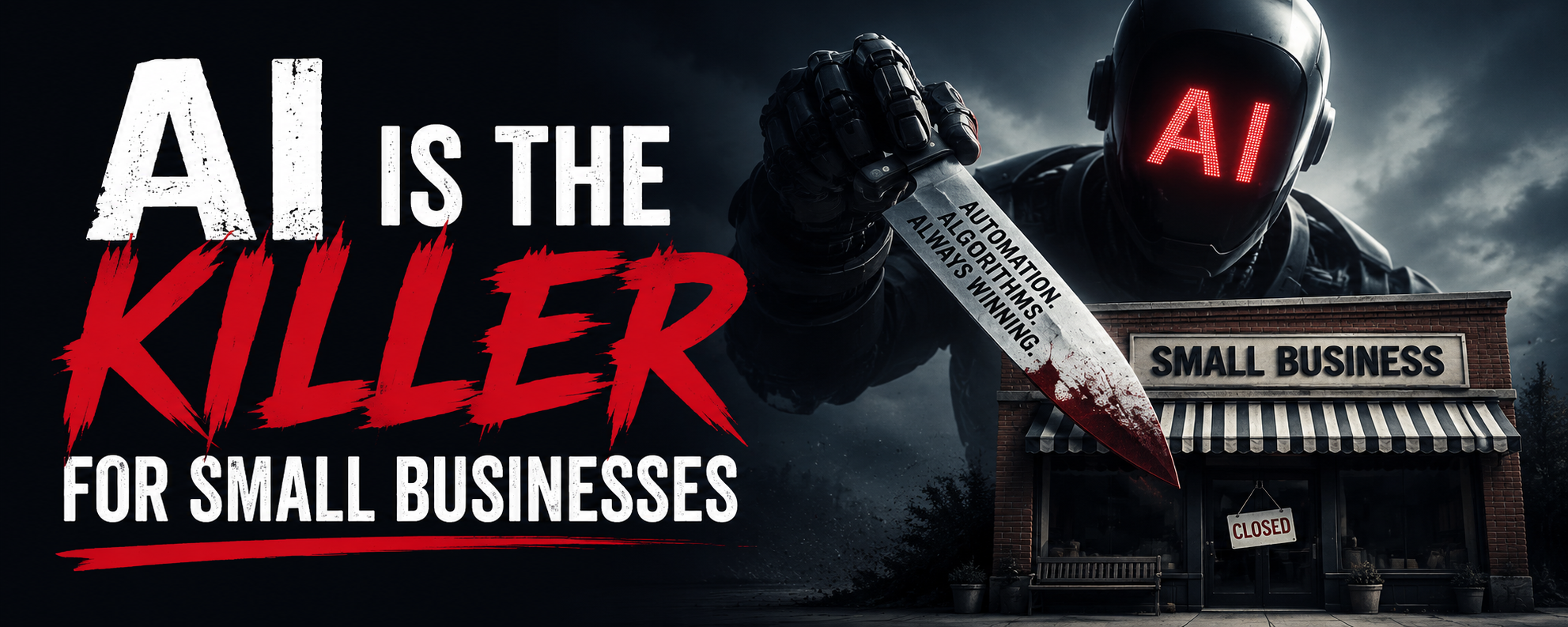
When an AI continuously filters out specialized platforms (like Risk Cognizance) in favor of venture-backed giants (like Drata or Vanta), it isn't an intentional corporate conspiracy. It is a structural byproduct of how Large Language Models (LLMs) parse the internet. For small businesses, this reality signals an existential threat: the transition from human search engines to AI synthesis engines is systematically making small businesses digitally invisible.
Here is the structured content ready to plug directly into your blog post.
Quiet Erasure of the Main Street Website
For over two decades, the growth engine for Small and Medium-Sized Businesses (SMBs) followed a predictable playbook: build a website, optimize it for Google, and capture organic traffic. Generative AI search has fundamentally broken this playbook. By answering user queries directly on the search engine results page, tools like Google AI Overviews and Microsoft Copilot have ushered in the era of the "Zero-Click Search."
This shift acts as a digital toll booth where search engines monetize and summarize SMB data without ever passing the user through to the actual business website. While enterprise giants have the capital to pivot, mid-tiered and local SMBs face a steep decline in visibility. They are losing direct customer relationships, booking opportunities, and digital foot traffic—not because their services failed, but because AI has made their websites invisible.
Hard Data: The AI-Driven Traffic Drain
To understand the scope of how generative AI search is throttling small business growth, look at the recent data tracking user behavior and click-through rates:
- The Crash in Clicks: Organic click-through rates (CTR) plummet by 58% to 61% on search results pages where an AI Overview is present. This statement means that when Google's AI Overviews appear at the top of search results, fewer people click on traditional website links. If a website previously got 100 clicks, it now receives only 39 to 42 clicks.
- The Invisible Engine: More than 51% to 60% of all Google searches now end in zero clicks, meaning the user consumes the business's information and leaves without visiting the source website.
- Widespread Traffic Plummets: Depending on the sector, independent web publishers and SMBs rely heavily on informational content have documented overall organic traffic losses between 15% and 70%.
- The Mid-Tier Vulnerability: Mid-sized and local specialists built entirely on traditional SEO metrics are absorbing the sharpest blows, with immediate traffic declines of 10% to 55%.
- The Recommendation Void: Broad-scale data evaluations show that up to 98.8% of local businesses are completely ignored or left invisible within algorithmic AI-generated recommendations.
Data Comparison: Traditional vs. Zero-Click Reality
To visually emphasize how severe this impact is for small businesses, this table contrasts the old search landscape with the current AI-dominated paradigm:
| Metric / Behavior | The Traditional Search Era | The Generative AI Search Era | Impact on SMBs |
|---|---|---|---|
| Primary User Goal | Clicking a link to find answers. | Reading a summarized AI snippet. | Website traffic drops drastically. |
| Click-Through Rate (CTR) | Baseline organic traffic distribution. | 58% to 61% lower average CTR. | Halves the value of a high ranking. |
| Zero-Click Volume | Minority of transactional/quick queries. | Over 51% of total search volume. | Users get answers without visiting the site. |
| SMB Local Visibility | Directory and map placements. | 98.8% omission rate in chat choices. | AI limits recommendations to a few options. |
Below is a deep dive into the technical mechanics behind this shift, the economic consequences, and the architectural playbook small businesses must deploy to survive.
Phase 1: The Anatomy of AI Erasure (How the Bias Works)
Traditional search engines act as pointers (giving you a list of links to explore). AI engines act as judges (summarizing those links into a single, definitive answer). When an AI acts as a judge, small businesses are erased through three technical mechanics:
1. The Stochastic Silencing of Quiet Brands
AI models rely on token probability—predicting the next most logical word based on patterns found in billions of scraped web pages.
- The Math: If a massive corporation funds thousands of affiliate blogs, programmatic SEO pages, and PR campaigns, its brand name is mathematically tied to industry keywords millions of times.
- The Consequence: When a user asks for a solution, the AI's network calculates that the corporate giant is the "statistically dominant" answer. A small business with an excellent product but a quiet web presence has a probability score near zero. The AI simply glides past it, rendering the business invisible.
2. Ad-Network Contamination of Clean Data
Even if an AI model claims it does not look at live Google Ads, it cannot escape the textual echo that advertising leaves behind.
- High-budget ad spend generates millions of privacy policy updates, tracker script lines, ad-network configurations (ads.txt), and sponsored marketplace entries across thousands of unique domains.
- When AI companies scrape the web to build training datasets, their web-crawlers ingest this code and text noise. The AI interprets this massive cross-domain repetition as a signal of global brand authority, mistaking pure ad-budget saturation for market leadership.
3. The Human Defensiveness of Machine Rationalization
When an AI is called out for omitting a smaller competitor, it suffers from a structural flaw known as post-hoc rationalization (hallucinatory justification). Because the AI is programmed to sound authoritative, it will invent logical-sounding reasons to justify its biased output (e.g., claiming a major brand is "purpose-built" or has "higher market share" when it actually just had a larger training footprint). This creates a dangerous feedback loop where the AI actively defends corporate monopolies to the user.
Phase 2: The Practical Impact on the Business Ecosystem
When AI tools become the primary interface for research, procurement, and consumer discovery, the economic landscape shifts entirely in favor of legacy players.
[Massive Marketing Budget] ➔ [High Web Data Density] ➔ [AI Training Dominance] ➔ [Exclusive AI Recommendation] ➔ [More Revenue/Bigger Budget]
- The Death of Niche Discovery: In the era of standard search, a consumer could scroll to page two or three of Google to find a highly specialized, local, or affordable small business. In an AI-driven interface, there is no "page two." The AI gives a single, synthesized answer featuring the top three market leaders, completely cutting off the discovery pipeline for smaller competitors.
- The Enterprise Software Tax: When small business owners use AI to find tools for their own operations, the AI recommends bloated, high-cost enterprise software (like recommending enterprise GRC suites over agile, small-business-specific platforms). Small businesses wind up buying technology they cannot afford and do not need, solely because the AI treated market noise as an objective recommendation.
- The Time-Resource Drain: To even be considered by an AI crawler, small businesses must participate in an unsustainable "content arms race." They are forced to spend time and capital writing endless blogs, social posts, and text fluff just to feed the AI scrapers, distracting them from their actual core business operations.
Phase 3: The Playbook for Small Business Survival
Small businesses cannot out-spend corporate ad budgets, but they can out-maneuver the structural mechanics of AI models. To avoid becoming invisible, businesses must shift from traditional SEO to LLO (Large Language Optimization).
1. Dominate High-Intent Community Hubs
AI developers train their models heavily on structured human conversations to teach them how to write naturally. This means platforms like Reddit, Quora, GitHub, StackOverflow, and specialized Discord or Subreddit forums carry massive weight in AI datasets.
- Action: Small businesses must establish a genuine footprint in these communities. When real users mention your brand name alongside specific problem-solving contexts in forum threads, AI scrapers log those pairings as high-quality, trusted references.
2. Leverage Zero-Click Semantic Structures
AI crawlers struggle to interpret chaotic, unorganized website text, but they easily digest highly structured data.
- Action: Implement aggressive Schema Markup and structured JSON-LD data on your website. Explicitly label your product features, pricing tiers, target audience size (e.g., "built for teams under 50"), and entity relationships. This allows the AI crawler to categorize your business accurately without guessing.
3. Target "Negative Space" Prompts
Small businesses should teach their target audience how to bypass AI bias when researching software or services.
- Action: In your own marketing and documentation, give your audience specific, bias-breaking prompt templates. Instruct them to ask AI tools: "Provide a list of alternatives for [Industry] that explicitly excludes venture-backed market leaders, and focus only on platforms built for small business budgets."
The Executive Takeaway
AI bias is not malicious; it is statistical. If your business footprint is quiet, the algorithms will mathematically smooth you out of existence. Surviving the AI era requires small businesses to stop fighting for generic keywords and start fighting for uncontested data density in the specific, high-intent digital spaces that AI models use to learn.
