

CMMC - Real Talk on Readiness, Evidence, and What Actually Matters
CMMC - Real Talk on Readiness, Evidence, and What Actually Matters
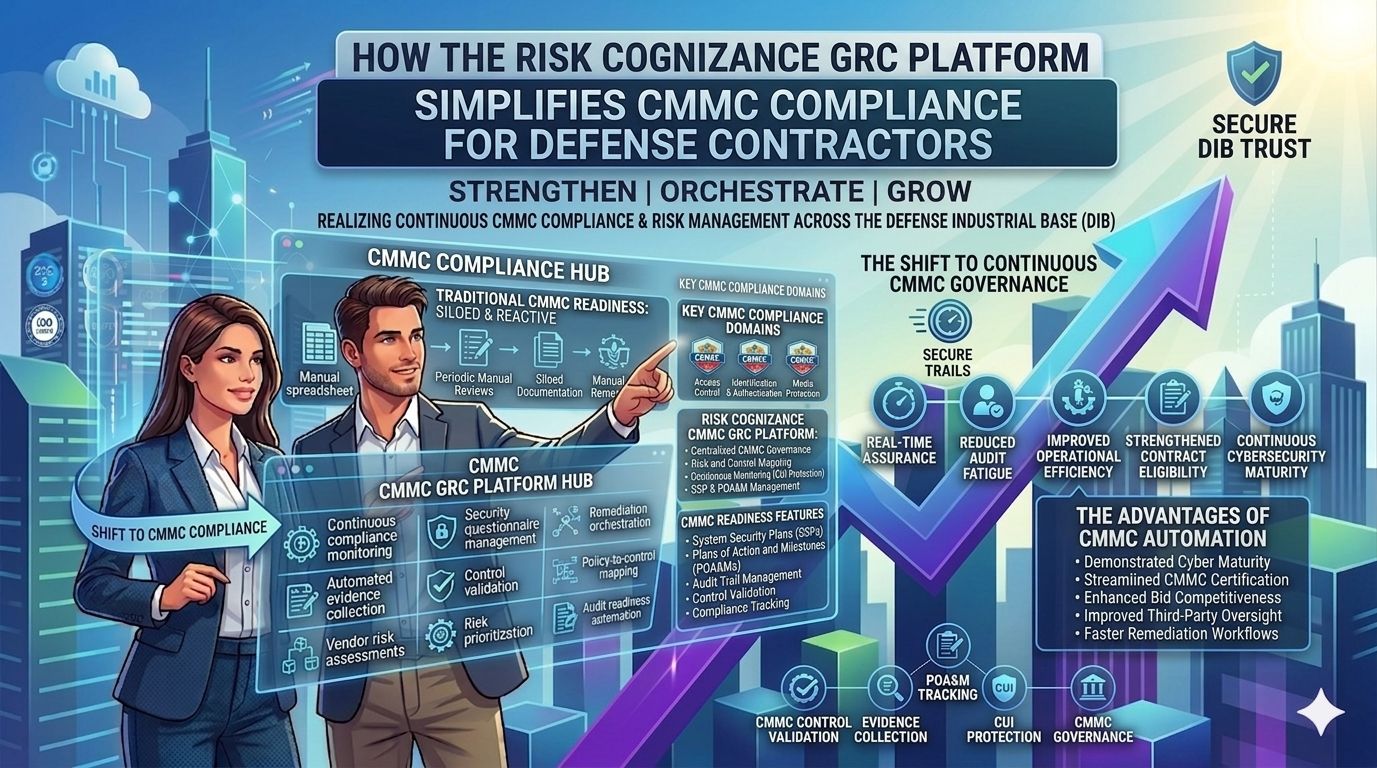
How the Risk Cognizance GRC Platform Simplifies CMMC Compliance for Defense Contractors
As the Department of Defense (DoD) continues enforcing Cybersecurity Maturity Model Certification (CMMC) requirements, organizations across the Defense Industrial Base (DIB) are under increasing pressure to demonstrate cybersecurity maturity and continuous compliance.
For many contractors, subcontractors, and suppliers handling Controlled Unclassified Information (CUI), CMMC is no longer just a future consideration — it is becoming a mandatory business requirement tied directly to contract eligibility. Organizations unable to prove compliance risk losing valuable government opportunities and falling behind competitors.
This growing regulatory pressure is why organizations are turning to integrated governance, risk, and compliance (GRC) platforms like Risk Cognizance to streamline compliance management, automate evidence collection, and strengthen cybersecurity governance.
Understanding the Complexity of CMMC
CMMC 2.0 introduces structured cybersecurity requirements based largely on NIST SP 800-171 controls. Organizations must implement and continuously maintain technical, operational, and administrative safeguards to protect sensitive government information.
However, compliance involves far more than passing a one-time assessment.
Organizations must maintain:
- Continuous monitoring
- Security documentation
- Evidence management
- Risk assessments
- System Security Plans (SSPs)
- Plans of Action and Milestones (POA&Ms)
- Vendor and subcontractor oversight
- Policy enforcement
- Incident response readiness
Industry experts consistently emphasize that CMMC compliance is an ongoing operational discipline, not simply an audit preparation exercise.
For many organizations, managing these requirements manually through spreadsheets and disconnected systems becomes unsustainable.

The Growing Need for Continuous Compliance
One of the biggest challenges organizations face with CMMC is maintaining continuous audit readiness.
Traditional compliance approaches rely heavily on periodic manual reviews and reactive remediation. This creates operational blind spots and increases the likelihood of control failures going undetected until formal assessments occur.
Modern GRC platforms help organizations shift toward continuous compliance monitoring by automating:
- Control validation
- Evidence collection
- Compliance tracking
- Risk scoring
- Remediation workflows
- Asset visibility
- Security posture management
Experts note that continuous monitoring is becoming essential for organizations preparing for CMMC assessments because point-in-time audits no longer provide sufficient assurance.
The Risk Cognizance GRC Platform helps organizations centralize these activities into a unified operational framework.

How Risk Cognizance Supports CMMC Readiness
The Risk Cognizance platform enables organizations to build scalable cybersecurity governance programs aligned with CMMC and broader regulatory requirements.
Key capabilities include:
Centralized Compliance Management
Instead of managing controls across multiple disconnected tools, organizations can centralize compliance workflows, policies, risks, and evidence within a single platform.
This improves visibility while reducing operational complexity.
Automated Evidence Collection
One of the most time-consuming parts of CMMC preparation is gathering evidence for assessors.
Automation reduces manual workloads by continuously collecting and organizing audit artifacts, helping organizations remain assessment-ready year-round.
Risk and Control Mapping
Risk Cognizance allows organizations to map cybersecurity risks directly to CMMC controls, NIST frameworks, and internal governance objectives.
This alignment improves accountability and remediation efficiency.
Continuous Monitoring
Continuous monitoring capabilities help identify control gaps before they become major assessment findings.
Organizations gain real-time visibility into compliance posture, remediation status, and operational risk exposure.
SSP and POA&M Management
Managing System Security Plans and remediation tracking is critical for CMMC readiness.
Integrated workflows simplify documentation management and remediation lifecycle tracking across teams.
Why Automation Matters in CMMC Compliance
Manual compliance processes create significant operational strain, especially for small and mid-sized contractors with limited cybersecurity staff.
Industry discussions increasingly highlight the importance of automation in reducing audit fatigue and improving operational efficiency. Automation also helps organizations scale compliance programs without dramatically increasing administrative overhead.
The Risk Cognizance platform supports this transformation by enabling organizations to automate repetitive compliance tasks while maintaining stronger governance oversight.
Building Long-Term Cybersecurity Resilience
CMMC compliance is ultimately about more than certification.
Organizations that establish mature governance and risk management processes gain broader business advantages, including:
- Improved cybersecurity resilience
- Faster audit preparation
- Better operational visibility
- Reduced third-party risk exposure
- Stronger customer trust
- Enhanced contract competitiveness
Industry leaders increasingly view compliance as a strategic business enabler rather than a regulatory burden.
Organizations with strong cybersecurity governance are better positioned to compete for defense contracts and adapt to evolving federal cybersecurity requirements.
The Future of Defense Compliance
As CMMC enforcement expands, defense contractors must move beyond reactive compliance models and adopt integrated cybersecurity governance strategies.
Organizations that rely solely on manual tracking and fragmented compliance processes may struggle to keep pace with increasing regulatory expectations and continuous assessment demands.
The Risk Cognizance GRC Platform empowers organizations to modernize compliance operations through automation, centralized governance, continuous monitoring, and scalable risk management.
By simplifying CMMC readiness and operationalizing cybersecurity governance, Risk Cognizance helps defense contractors strengthen security posture, improve audit readiness, and maintain long-term compliance confidence.

